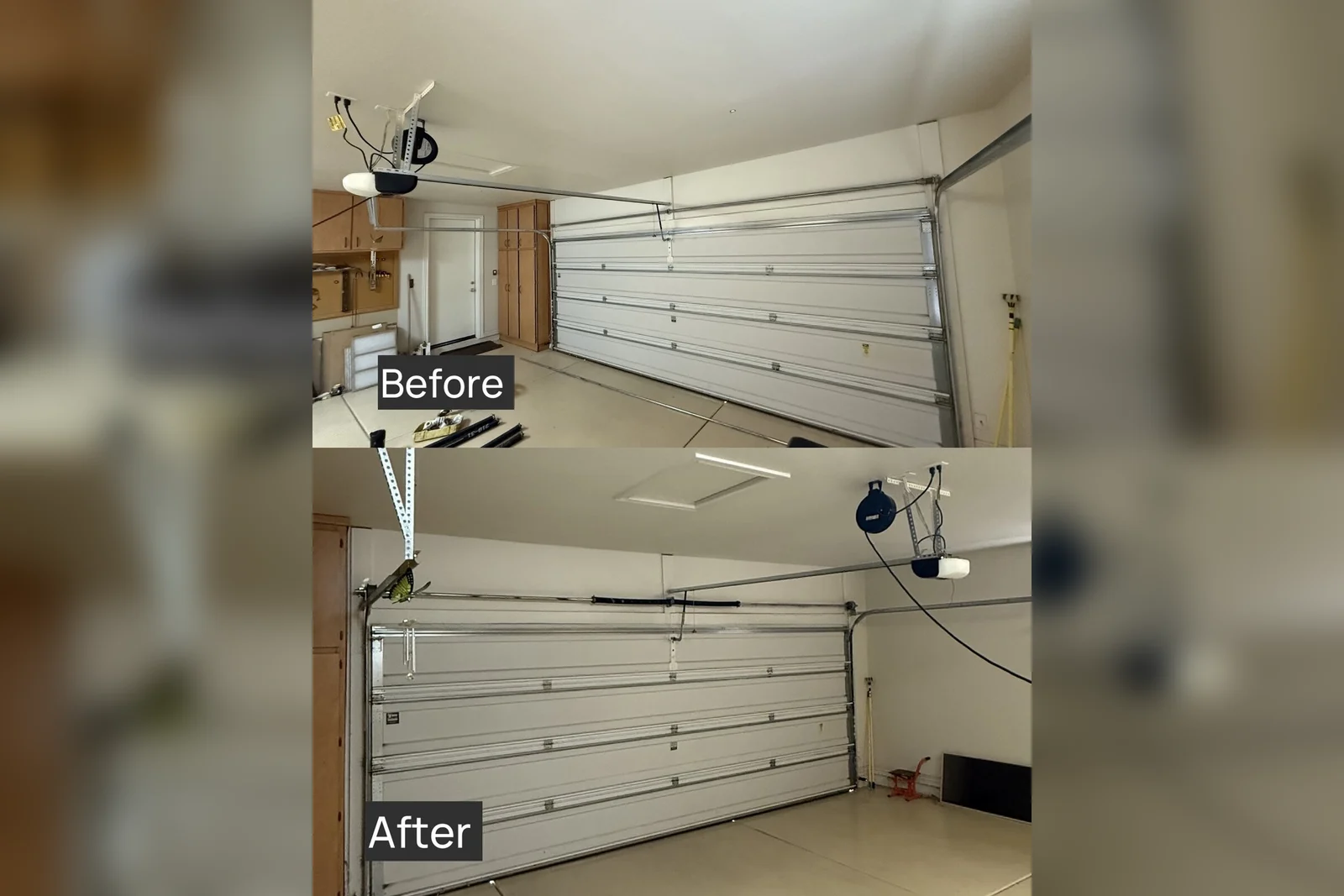
If you look up at your open garage door and see a smooth metal tube running across the top with no visible springs, there is a good chance you have a Wayne Dalton TorqueMaster system.
Many homes across Phoenix and the Valley were built with this design.
It was popular because it looks clean and hides the spring inside the tube.
But when a TorqueMaster system fails, it often fails without warning, and it can be harder to service than a standard garage door.
This guide explains how the Wayne Dalton TorqueMaster system works, the common problems it develops, the warning signs to watch for, and why many homeowners choose to convert it to a standard torsion spring setup.
What Is the Wayne Dalton TorqueMaster System?
The Wayne Dalton TorqueMaster is a counterbalance system for garage doors.
On most garage doors, the torsion spring is mounted out in the open, on a bar above the door, where you can see it.
The TorqueMaster is different.
Instead of mounting the spring on the outside, it places the spring inside the torsion tube, sealed away from view.
That is why a TorqueMaster door has that clean, smooth look with no spring showing.
Some TorqueMaster systems use a single spring inside the tube, and some use two.
The cables that help lift the door are wound onto drums at each end, just like a standard system, but the spring that powers everything stays hidden inside the tube.
It is a clever design, but the same thing that makes it look clean also makes it harder to inspect and service.
How the TorqueMaster System Works
Every garage door needs a counterbalance.
The door is heavy, and the opener is not built to lift that full weight on its own.
The spring does most of the lifting, and the opener simply guides the door up and down.
On a TorqueMaster, the hidden spring is wound to a set amount of tension when it is installed.
That stored tension balances the weight of the door.
When the system is working correctly, the door should:
- Feel balanced and controlled
- Open and close smoothly
- Stay in place when stopped partway
- Not slam down or fly up
- Require little effort from the opener
Because the spring is sealed inside the tube, a TorqueMaster relies on proprietary Wayne Dalton parts.
When something inside the tube wears out or breaks, there is no exposed spring to look at, which makes the problem harder to spot before it leaves you stuck.
Common Wayne Dalton TorqueMaster Problems
Like any spring system, a TorqueMaster wears out over time.
Every open and close cycle puts stress on the spring and the parts around it.
Here are the problems we see most often with Wayne Dalton TorqueMaster systems:
- A broken internal spring hidden inside the tube
- The door suddenly becoming dead weight and refusing to open
- Frayed or snapped cables sealed inside the system
- Worn or cracked plastic winding cones
- Difficulty finding proprietary TorqueMaster replacement parts
- Repeated failures on an older door that has already been repaired once
One of the biggest frustrations with a TorqueMaster is that the failure is hidden.
With a standard exposed spring, you can often see the gap where a spring has broken.
With a TorqueMaster, the spring breaks inside the tube, so the first sign is usually a door that simply will not open.
Warning Signs Your TorqueMaster May Be Failing
A TorqueMaster does not always give a lot of warning, but there are signs worth paying attention to.
You may have a failing or broken TorqueMaster system if:
- You heard a loud bang from the garage, which can be a spring letting go
- The door will not lift, or the opener strains and then gives up
- The door feels extremely heavy when you try to lift it by hand
- The door only rises a few inches and stops
- A previous TorqueMaster repair has already failed again
- The cables have gone loose or come off the drums
If your garage door will not open and you have a TorqueMaster, stop pressing the opener button.
Forcing the opener to lift a dead-weight door can strain or damage the motor and gears.
At that point the safest step is to have the system inspected by a professional.
Why TorqueMaster Repairs Often Do Not Last
A TorqueMaster can be repaired.
The internal spring and cables can be replaced with Wayne Dalton parts.
But there are a few reasons the same failure tends to come back.
First, the parts are proprietary, which can make sourcing them slower and less convenient than standard hardware.
Second, the system is sealed, so servicing it means working around an enclosed tube instead of open, accessible parts.
Third, if a TorqueMaster has already failed once on an older door, the rest of the system has usually seen the same wear, and another failure may not be far behind.
This is why many homeowners decide that instead of repairing the TorqueMaster again, it makes more sense to convert the door to a standard torsion system.
Converting a TorqueMaster to a Standard Torsion System
A TorqueMaster conversion swaps the enclosed tube system for a standard exposed torsion spring setup.
This is the same dependable design found on most garage doors.
The springs, drums, and cables are mounted out in the open, where they can be seen, inspected, and serviced easily.
Converting a TorqueMaster to standard torsion offers several advantages:
- Springs and hardware mounted in the open, not sealed inside a tube
- Standard, widely available parts instead of proprietary sourcing
- Faster, simpler repairs in the future
- Easier inspection, so problems can be spotted before they leave you stuck
- High-cycle spring options built to last longer in Arizona's heat
Once a door is converted, a future spring replacement becomes a routine job instead of a specialty repair.
You can learn more about the process on our TorqueMaster conversion service page.
What a TorqueMaster Conversion Involves
A proper conversion is more than just swapping one spring for another.
A technician should inspect the whole door and set the new system up correctly.
A typical TorqueMaster conversion includes:
- Confirming the door has a TorqueMaster system and weighing the door
- Measuring for the correct torsion springs, shaft, drums, and cables
- Safely removing the enclosed TorqueMaster tube and releasing any stored tension
- Installing a new torsion shaft, correctly sized springs, drums, and cables
- Winding the springs to the exact turns for the weight of the door
- Balancing the door and testing the opener and auto-reverse safety feature
- Walking you through the new setup so you know what you have
The final testing step matters.
A properly balanced door moves smoothly and takes stress off the opener, which helps the whole system last longer.
Should You Repair or Convert Your TorqueMaster?
Not every TorqueMaster needs to be converted right away.
A one-time repair may be reasonable if the system is relatively new, only one part failed, or you are planning to replace the entire door soon anyway.
Converting to a standard torsion system usually makes more sense when:
- You have already had a TorqueMaster failure, or more than one
- You want quick, straightforward repairs in the future
- You would like high-cycle springs for a much longer service life
- You plan to keep the door for years to come
A professional inspection can help you decide.
The goal is to choose the option that keeps your door safe and reliable for the long term, not just to get it moving again for a few more months.
TorqueMaster Service in Phoenix and the Valley
The Wayne Dalton TorqueMaster system was a common choice in Arizona homes, and it can work well for years.
But when the hidden spring finally fails, you are often left with a door that will not open and a system that is harder to service than a standard setup.
Desert Spring Garage Door Repair works on TorqueMaster systems every day.
We can inspect your door, explain what is happening inside that sealed tube, and help you decide whether a repair or a full conversion to standard torsion is the right call.
If your garage door has a smooth tube across the top, feels heavy, or will not open, do not keep forcing the opener.
Contact Desert Spring Garage Door Repair to schedule an inspection and get honest guidance on your TorqueMaster system. Call or text (602) 694-3212.